The Book of Yourself Newsletter
Issue 54: May 2026
|
|
|
In the most recent newsletters I have been concentrating on the theme of education. This is mostly a consequence of having conducted, at KFA’s invitation, a five-day workshop on K’s Education and the Significance of Life. Understanding K’s vision of education is a work in progress for educators inspired by his teachings. The relevance of the latter to the current world situation is undeniable and the need for a new and holistic kind of education and approach to life was never more urgent. There is therefore a need to work through what K understands by education in order to make it intelligible and widely accessible. This is no easy task, especially since K denied method, system and practice. Every system creates its own methods and practices in order to achieve a given result. But that very goal-oriented approach tends to the mechanical and becomes a limitation on learning, and especially on self-learning, which not only necessitates reflection but the spontaneity of instant awareness in relationship. Conveying the central importance of this to the educators is one of the primary challenges stemming from what K proposed as the right kind of education, whose essence is the cultivation of self-knowledge as the key to the transformation of consciousness and the creation of a new culture.
|
|
As we saw in the previous newsletter, the problem in education is not the child but the adult. In that text we attempted to address some of the implications of right education for parents, not just as educators but as human beings concerned with bringing about a new humanity and a new world. The responsibilities involved are not coming from some authoritative plan for educational improvement or some ideological or confessional approach, but they follow naturally if we love our children. We could say that our love is our responsibility. And whether we love them or not is shown by the consequences of our actions on their lives. Today we are going to take a similar look at the implications of right education for teachers.
|
|
For K, teaching is the greatest profession in life, greater than all the riches of this world, for on the teachers depends the quality of the new generations and the needful transformation of humanity in order to bring about a peaceful and cooperative world. They have an extra responsibility, as it were, because the parents generally delegate the education of their children on them. They are, for all practical purposes, legally obliged to do so. And as the parents are too busy earning a living and pursuing their own interests, they have very little time to function as educators, so they leave it to the teachers, who mostly function within a system designed and guided by the interests of by the State. So the teacher who already understands his deeper responsibility may have to educate the parents about what all is involved in this new approach, so they are on the same page.
|
|
“He must talk to them, explaining that the confused state of the world mirrors their own individual confusion. He must point out that scientific progress in itself cannot bring about a radical change in existing values; that technical training, which is now called education, has not given man freedom or made him any happier; and that to condition the student to accept the present environment is not conducive to intelligence. He must tell them what he is attempting to do for their child, and how he is setting about it. He has to awaken the parents' confidence, not by assuming the authority of a specialist dealing with ignorant laymen, but by talking over with them the child's temperament, difficulties, aptitudes and so on.”
|
|
Education and the Significance of Life, pg. 102
|
|
This simple paragraph might be already quite challenging in terms of how education is generally viewed. To begin with, one has to be aware of the confusion in the world and then realise that the outer mirrors the inner. It is framed within the global perspective that we are the world and the world is us, which is the ground of our total responsibility as human beings. A whole human being is the only answer to a broken world. Next, it throws a spanner in the works of scientific progress as the solution to our problems because technology cannot change the existing values responsible for the chaos in society, nor can it bring freedom and happiness to humanity. Only a profound inner revolution can do that. Therefore education cannot be a means of conditioning the child to fit into such an environment. This would indeed be a denial of its fundamental responsibility to bring about sensitive, intelligent and caring people, free from such false values and false hopes. That’s already a lot for a parent to take, beginning with the fact that the same applies to them. Most parents are primarily concerned with securing the future of their children within the existing system and this approach questions its foundations. So the teacher has a good deal of explaining to do, for his pedagogical approach is not in keeping with the general programme. The teacher has indeed to gain the parents’ confidence, not by speaking ex cathedra but by showing his total concern for the individual child.
|
|
|
|
“The problem is not only the student's difficulties, but our own: the cumulative fears, unhappiness and frustrations of which we are not free. In order to help the child to be intelligent, we have to break down within ourselves those hindrances which make us dull and thoughtless. How can we teach children not to seek personal security if we ourselves are pursuing it? What hope is there for the child if we who are parents and teachers are not entirely vulnerable to life, if we erect protective walls around ourselves? To discover the true significance of this struggle for security, which is causing such chaos in the world, we must begin to awaken our own intelligence by being aware of our psychological processes; we must begin to question all the values which now enclose us. We should not continue to fit thoughtlessly into the pattern in which we happen to have been brought up. How can there ever be harmony in the individual and so in society if we do not understand ourselves? Unless the educator understands himself, sees his own conditioned responses and is beginning to free himself from existing values, how can he possibly awaken intelligence in the child? And if he cannot awaken intelligence in the child, then what is his function?”
|
|
Education and the Significance of Life, pp. 105-106
|
|
This approach to education begins with the educators’ difficulties. To help the child to be free we need to break down those inner hindrances that make us careless and insensitive. One of them is the pursuit of security, which is one of the major causes of chaos and violence in the world. The struggle for security, with its fear, aggression and frustration, implies the building of walls and the denial of our total vulnerability to life. That is the standard pattern of our upbringing, whereas the purpose of a holistic education is not to turn us into cogs in the social machine but to help us to be integrated, free and creative human beings. For that, the teacher must be constantly and intensely aware of his own thoughts and feelings, of his conditioned activities, for out of this watchfulness comes intelligence, and with it a radical transformation in relationship to things, people and ideas. For intelligence is the quality of spontaneous perception that sees directly into the actuality of things, thus freeing us from the bondage of conditioning, with its mechanicalness and false values. (The mechanicalness of the past negates perception and, thereby, the meaning of its values, for they don’t respond to what is.)
|
|
“Right values are not discovered through the authority of society or tradition; only individual thoughtfulness can reveal them. If one understands this deeply, one will encourage the student from the very beginning to awaken insight into present-day individual and social values. One will encourage him to seek out, not any particular set of values, but the true value of all things. One will help him to be fearless, which is to be free of all domination, whether by the teacher, the family or society, so that as an individual he can flower in love and goodness. In thus helping the student towards freedom, the educator is changing his own values also; he too is beginning to be rid of the ‘me’ and the ‘mine,’ he too is flowering in love and goodness. This process of mutual education creates an altogether different relationship between the teacher and the student.”
|
Education and the Significance of Life, pg. 108
|
|
The discovery of the right value of all things is a matter of insight, which is the action of intelligence. This intelligence is prevented by authority and its crippling fear, which deny it the needful freedom. So the educator cannot function as an authority to fear or a model to imitate. For goodness can only flower in love and freedom, and such structures deny them. In the process of helping the student towards freedom, the teacher also drops the values grounded on the ‘me’ and the ‘mine’. Thus the relationship between the teacher and the student brings them together in the transformative and liberating process of learning. Both are then open to understanding themselves in the mutual education that relationship always is. This in turn changes the meaning of teaching, what one is teaching for.
|
“One teaches because one wants the child to be rich inwardly, which will result in his giving right value to possessions. Without inner richness, worldly things become extravagantly important, leading to various forms of destruction and misery. One teaches to encourage the student to find his true vocation, and to avoid those occupations that foster antagonism between man and man. One teaches to help the young towards self-knowledge, without which there can be no peace, no lasting happiness. One's teaching is not self-fulfilment, but self-abnegation. Without the right kind of teaching, illusion is taken for reality, and then the individual is ever in conflict within himself, and therefore there is conflict in his relationship with others, which is society. One teaches because one sees that self-knowledge alone, and not the dogmas and rituals of organized religion, can bring about a tranquil mind; and that creation, truth, God, comes into being only when the "me" and the "mine" are transcended.”
|
Education and the Significance of Life, pg. 115-116
|
One other way K used to put it, is that education is to give all things in life their right place. That also means giving them their right value. The lack of inner riches causes us to exaggerate the importance of possessions, which becomes a cause of conflict and sorrow. It also implies the discovery of one’s true vocation, for in loving what one does there is no competition and antagonism, which goes together with a concern with right livelihood. Self-knowledge is central, for it is at the core of happiness and freedom. Teaching itself is not a form of self-fulfilment but of self-abnegation, for it is the way of dissolving the factors of division and conflict within and without that stem from the rootedness of consciousness in the ‘me’ and the ‘mine’. That’s why K called his approach holistic. Not only because it is concerned with bringing about a whole human being and a peaceful world free from division and conflict, but because the quality of wholeness that comes through freedom from self-centredness is at the core of what he called the religious mind. Wholeness is goodness and an education that’s totally committed to the flowering of goodness is essentially religious. Not in any traditional or sectarian sense, but as the inner riches that are the significance of life.
|
|
Take care, amigos, and let’s keep learning in the mutual education of relationship,
|
|
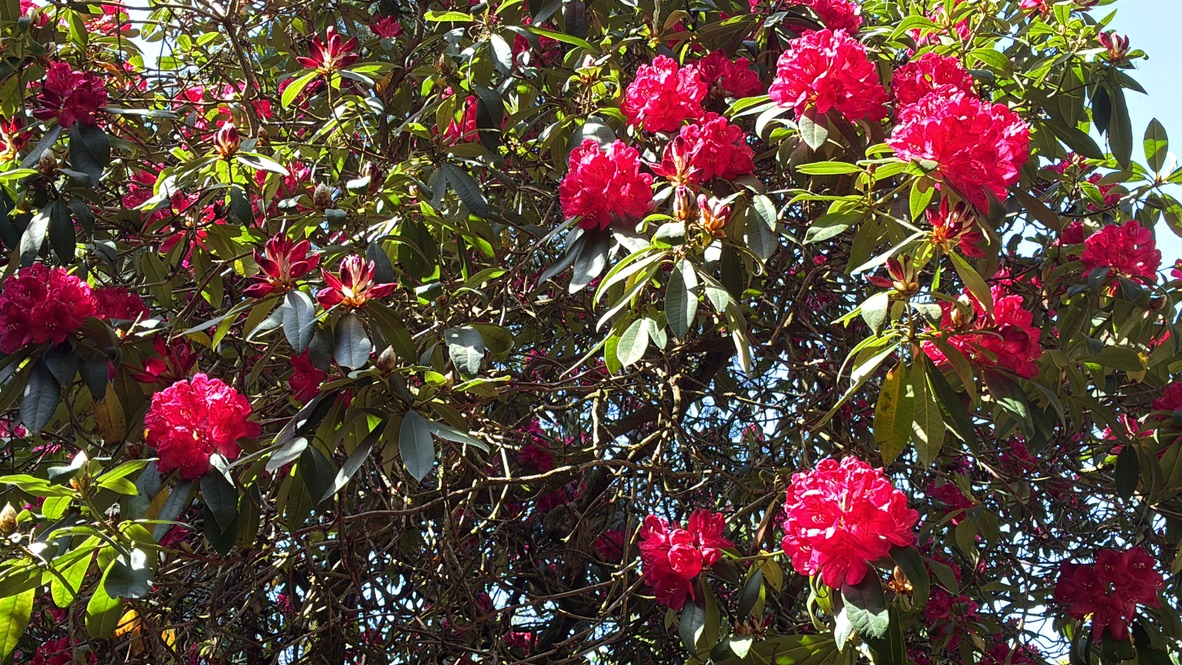
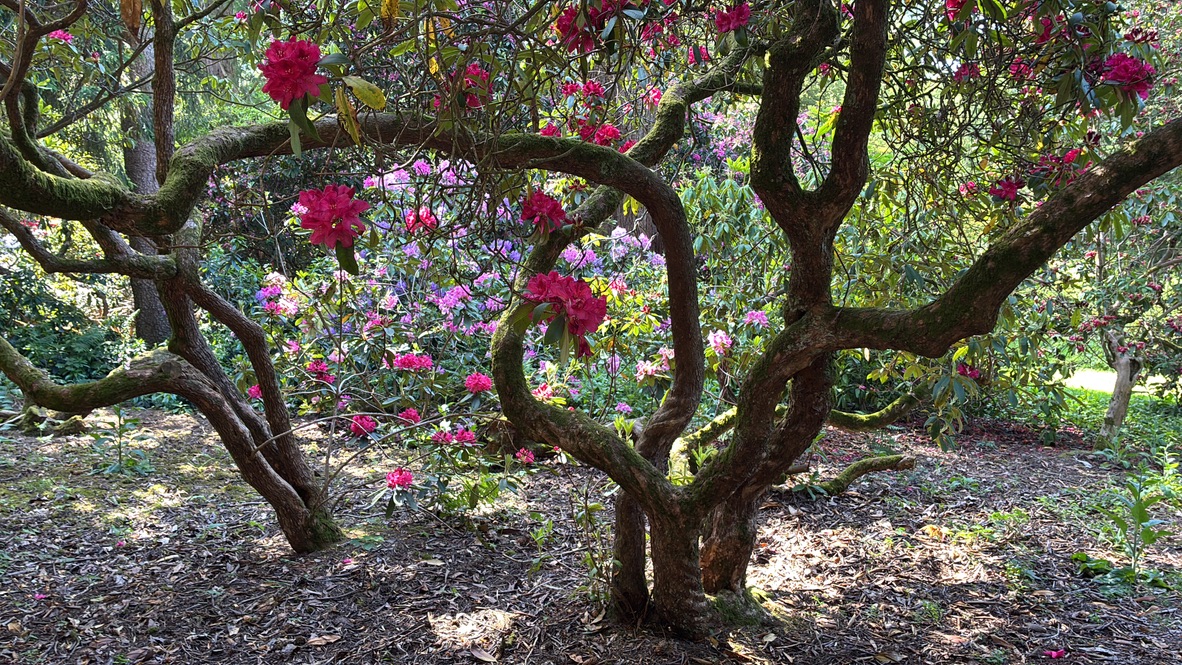
Photos by J. Gómez Rodríguez: 1. and 2. Rhododendrons in the Grove, Brockwood Park, Bramdean, UK.
|
|
|
|
|
|
|
|
|
